Editorial | The National | July 2, 2026
If it were within our power, we would call for a cessation of payment of all Services Improvement Programme (SIP) funds 12 months before any national elections.
There are two related reasons for our proposal.
Firstly, the funds will most certainly be directed to politically convenient avenues, including non-existent projects, just to garner support for the elections.
Secondly, putting a stop to SIP funding gives a level playing field to all aspiring politicians as well as the incumbents to contest the field as equals.
Sitting MPs should not be affected in the slightest if they have been applying funds and attention to their electorate in the last four years.
But since it is not within our power and any such suggestion would never see light of day by way of it moving through Parliament, we shall inform the public that there are strict guidelines for use of these funds.
Members of the public should familiarise themselves with these Guidelines and the break-up stipulated for them and supported by Financial Instructions for their use.
Any MP who allocates any funds through his District Development Authority must clearly spell out whether or not the money is coming from SIP funds.
Members of the public have every right to ask the MP to spell out what sector he or she is spending the money on and whether it follows the Administrative Guidelines and the Financial Instructions.
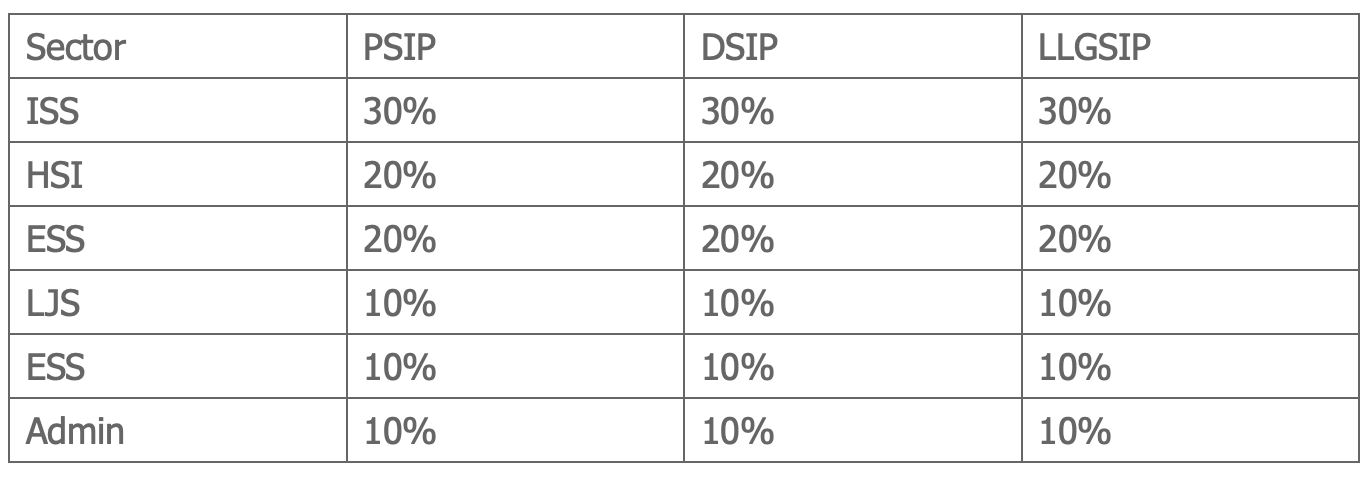
The National Executive Council (NEC) decision number 204 of 2018, dated August 16, directed that Provincial Services Improvement Programme (PSIP) funds, District Services Improvement Programme (DSIP) funds and Ward level services improvement funds be allocated to five sectors.
A Financial Instruction of even date supports the Administrative Guideline.
These sectors were Infrastructure Service Support (ISS); Health Services Improvement (HSI); Education Services Support (ESS); Law and Justice Sector (LJS); Economic Sector Support (ESS) and Administration (Admin).
Funds were to be distributed in the following manner:
The prerequisite for annual SIP disbursement are the following: a rolling five-year development plan; a budget to accompany the plan; meeting minutes and resolutions and annual activity plans.
The 2018 Guideline does stipulate that disbursement of SIP funds is not mandatory but subject to cash-flow situation but it is conditional that any available funding will be released ONLY upon the receipt of the previous year’s SIP implementation reports.
Failure to comply with this is deemed, under the guidelines, to be a serious breach of Administrative Guideline and the Finance Instruction.
“SIP funds shall NOT be disbursed by Department of Implementation and Rural Development (DIRD) to provinces, districts and LLGs unless the preceding year’s reports are submitted, appraised and certified by SIP interagency (DIRD, Finance, National Planning & Monitoring, Treasury) Clearance Committee,” the Guideline makes clear.
Even the 10 per cent of Administration cost is accounted for. One percent is to be earmarked for DIRD expenses for monitoring and performance audit. For clarity this means that out of every K1,000,000 received under SIP funding, DIRD is able to use K10,000.
Equal percentages are then to be allocated for administrative support including joint planning and budget priority committee; MP electoral support for travel and project identification and project scoping costs and related activities.
Strict rules are prescribed under the Finance Guidelines for procurement which were to follow the National Procurement Act 2018.
Any procurement in excess of K500,000 is within the sole jurisdiction of the National Procurement Commission, including its provincial and district committees.
An authority to pre-commit (APC) expenditure is required for proposed expenditure of K500,000 or above. Contracts would be null and void without the required APC for those amounts.
A copy of all signed contracts, irrespective of value (including delivery schedules and billing or claims schedule) shall be furnished by the provincial administrator or chief executive officer of the District development authority (DDA) to DIRD within one week of the signing of the agreement.
These and other specifications made under the guidelines and the finance instructions clearly spell out how these public funding is to be used.
The big question here is: Are these guidelines and financial instructions being followed? More especially, are the responsible agencies — DIRD, Finance, National Planning and Monitoring, and Treasury — insisting upon compliance.
The money would not be in the provinces or districts unless they are released by the central agencies.
And it behooves each agency to insist upon compliance of these guidelines before any release can be made in the first instance.